
Nine Dynastic Urns: Complete Guide to Hue Imperial Citadel Treasures

The Nine Dynastic Urns stand as one of Hue’s most striking royal treasures. Travelers visiting Hue Imperial Citadel often want to understand their history, their meaning, and how each urn connects to the Nguyen dynasty.
This guide walks through what makes these bronze urns special. It also covers the symbols carved into them, tips for visiting, and nearby places worth adding to any Hue itinerary.
History and Origin of the Nine Dynastic Urns

Emperor Minh Mang, the second Nguyen emperor, ordered the casting of these urns. He wanted a lasting symbol of dynastic power. Craftsmen from the Phuong Duc bronze workshop, the city’s most respected foundry, took on the task.
Casting began in October 1835. It continued until early 1837. That’s roughly a year and a half of nonstop metalwork. On 4 March 1837, an inauguration ceremony marked their completion. The urns then moved to The Mieu Temple permanently.
This temple honors Gia Long, Minh Mang’s father and the founder of the Nguyen dynasty. Each urn represents one enshrined emperor worshipped inside. Historians believe Minh Mang drew inspiration from China’s legendary Nine Tripod Cauldrons. Those ancient vessels symbolized the Emperor Yu’s authority centuries earlier.
More recently, in May 2024, UNESCO recognized the carved reliefs as Asia-Pacific documentary heritage. This marks Hue’s fourth heritage title of this kind.
Meaning of the Number Nine in Nguyen Dynasty Culture
Numbers carried heavy weight during Vietnam’s dynastic period. Nine stood for something bigger than counting objects. As the highest natural odd number, nine symbolized maximum power and completeness.
It also represented longevity. Nguyen kings hoped their dynasty would last forever, much like the number nine itself. That’s why so many royal items followed this same pattern.
Consider these examples:
- The Nine Holy Cannons, cast to celebrate an early military victory
- Nine dragon styles decorating the roof of Thai Hoa Palace
- Nine dragons embroidered on royal dragon robes
None of these choices were random. Each one reinforced the same message about eternal royal strength.
What Each Urn Represents
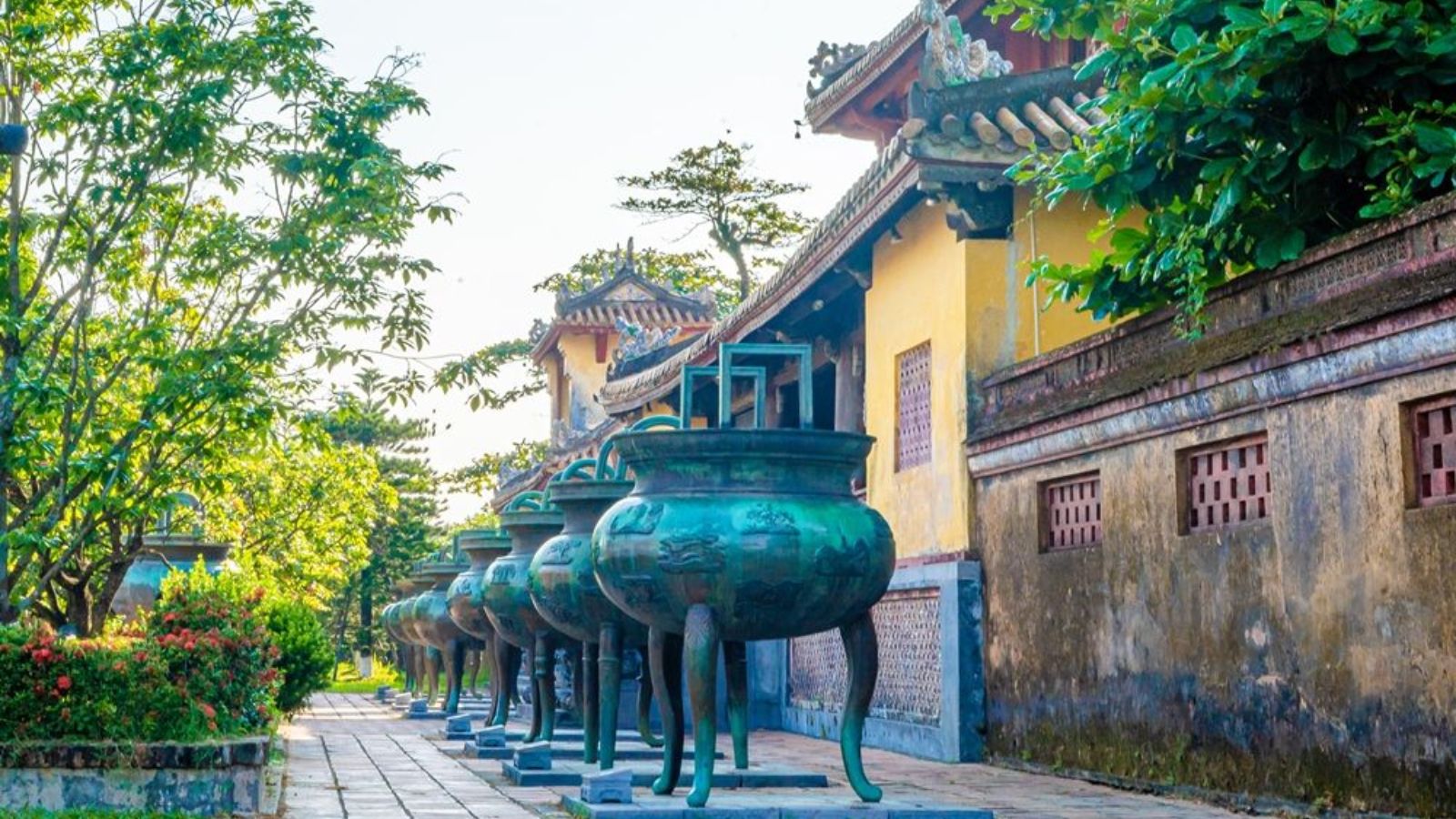
Every urn in this bronze collection honors one specific emperor. Before 1958, seven emperors were worshipped at The Mieu Temple. Each urn carries 18 carved panels total. Seventeen of those show symbols, while one displays the urn’s formal name.
The nine urns include Cao Dinh, Nhan Dinh, Chuong Dinh, Anh Dinh, Nghi Dinh, Thuan Dinh, Tuyen Dinh, Du Dinh, and Huyen Dinh. Cao Dinh honors Gia Long and holds the title “Great Urn.” Nhan Dinh represents Minh Mang himself.
Here’s something I find genuinely interesting. The position of each urn outside actually mirrors the altar arrangement inside The Mieu Temple. Cao Dinh, Gia Long’s urn, sits in the middle position among the nine. Step inside the temple, and you’ll notice Gia Long’s altar also sits right in the middle. It’s not a coincidence.
Each urn’s placement reflects the exact spot where that emperor’s altar stands inside The Mieu Temple.
The same pattern continues for the other emperors, urn by urn. That said, The Mieu Temple actually worships 10 emperors in total, not nine. Originally, only seven emperors matched up with seven of the nine urns. The two remaining urns don’t represent specific individual rulers. Instead, they carry broader symbolism that represent for the Nguyen Dynasty’s legacy
I like this detail because it shows how carefully planned the whole layout really is. Nothing here feels random. Every urn, every altar, every position ties back to the dynasty’s story as a whole.
The 162 Carved Symbols and Their Categories
Across all nine urns, you’ll spot 162 distinct symbols. These fall into neutral, everyday categories rather than purely royal imagery. Categories include:
- Stars and natural phenomena
- Major rivers and canals
- Mountains and mountain passes
- Animals, birds, and fish
- Grains, vegetables, and fruit trees
- Weapons, boats, and ships
One example worth noting is the Perfume River carving on Nhan Dinh. It flows directly past the Imperial City itself. Another sample shows Ngu Binh Mountain, often called Hue’s protective guardian peak.
Nine Dynastic Urns vs. Nine Holy Cannons
Visitors sometimes confuse these two bronze collections. Both share royal symbolism, yet their purposes differ quite a bit.
The Nine Dynastic Urns function as memorial vessels. They honor individual emperors and record national geography. The Nine Holy Cannons, by comparison, served a demo of military might. They celebrated Gia Long’s early victories rather than dynastic memory.
Location differs too. The urns sit inside The Mieu Temple. The cannons stand near the Citadel’s gates instead. If you like exploring contrasts between royal artifacts, comparing both sites side by side makes a rewarding stop.
Nine Dynastic Urns Visitors Guide

Visitor Information
Planning your visit requires checking a few basic details:
- Opening Hours: 7:00 – 17:30
- Ticket Price: 200,000 VND for adults (and children over 12 years old). This entry fee covers your access to the entire Citadel complex.
- Recommended Time: Spend 15 to 20 minutes viewing the reliefs.
Tips for Visiting
Dress code matters here, since this remains an active worship site. Wear long pants covering your knees. Choose tops that cover your shoulders, chest, and stomach. Skip anything sheer or see-through.
Weather changes what you should pack. During dry season, bring sunscreen, sunglasses, and a hat. Bottled water helps too, especially on hot afternoons. During rainy season, pack a rain poncho or umbrella. Waterproof shoes or sandals make walking easier.
Photography is welcome throughout the site. Feel free to snap pictures beside each individual urn.
Getting to the Nine Urns
The urns sit inside Hue Imperial Citadel, specifically within The Mieu Temple grounds. This puts them on the Perfume River’s northern bank, in the city’s Phu Xuan district.
Most travelers enter through the Citadel’s main gates, then walk toward The Mieu Temple area. It’s a manageable stroll, not a demanding trek. Comfortable shoes still help, since Citadel grounds stretch across a wide area.
Nearby Attractions to Visit After the Nine Urns

Once you’ve admired the urns, plenty more sits within walking distance. Inside the Citadel, you’ll find Thai Hoa Palace, Dien Tho Palace, and Thai Mieu Temple. Truong Sanh Residence and Kien Trung Palace round out the royal complex nicely. Explore the Imperial with local experts to deeply understand its history.
Near Ngo Mon Gate, additional sites await. The Museum of Royal Antiquities sits roughly 650 meters away. The Flag Tower stands even closer, just 100 meters off.
Beyond the Citadel walls, Hue offers even more. Thien Mu Pagoda, Dong Ba Market, and Truong Tien Bridge all sit within a short ride. For a full breakdown of must-see spots around the city, check this guide to sightseeing highlights in Hue. Book a full-day tour to explore Hue city entirely.
Personally, I like combining the urns with a Citadel walking tour. It’s a natural pairing, since both sites share the same royal history. If you’re short on time, even a quick visit to the urns alone makes for a memorable stop on your Hue trip.
