
Thieu Tri Tomb Guide: Architecture, Layout & Travel Tips
Skip Hue’s busiest tourist tombs and explore Thieu Tri Tomb, a truly unique imperial destination. Known locally as Xuong Lang, this quiet site offers a deep look into royal history, natural harmony, and regal craftsmanship. Visiting this complex lets you experience an authentic piece of history without the heavy crowds found elsewhere.
Thieu Tri Mausoleum Overview and Architectural Significance
Understanding the background of Thieu Tri Tomb makes your visit far more meaningful. Emperor Thieu Tri, named Nguyen Phuc Mien Tong, was the third monarch of the Nguyen Dynasty. He was the son of Emperor Minh Mang and ruled for seven years. Sadly, he passed away suddenly in 1847 at forty-one years old. Because he died unexpectedly, he had not constructed his final resting place yet.
His successor, King Tu Duc, ordered construction of Thieu Tri Tomb to honor his father. Emperor Thieu Tri requested a simple, modest, and cost-effective burial site.
Mandarin Vu Van Giai supervised the rapid construction process. The work began in February 1848, and workers completed the main structures by May 1848. The tunnel was completed on March 23, 1848, and King Tu Duc inspected the site on June 14, 1848. Ten days later, on June 24, 1848, workers interred the royal coffin. By November 1848, workers erected the main stele, bringing total construction time to just ten months.
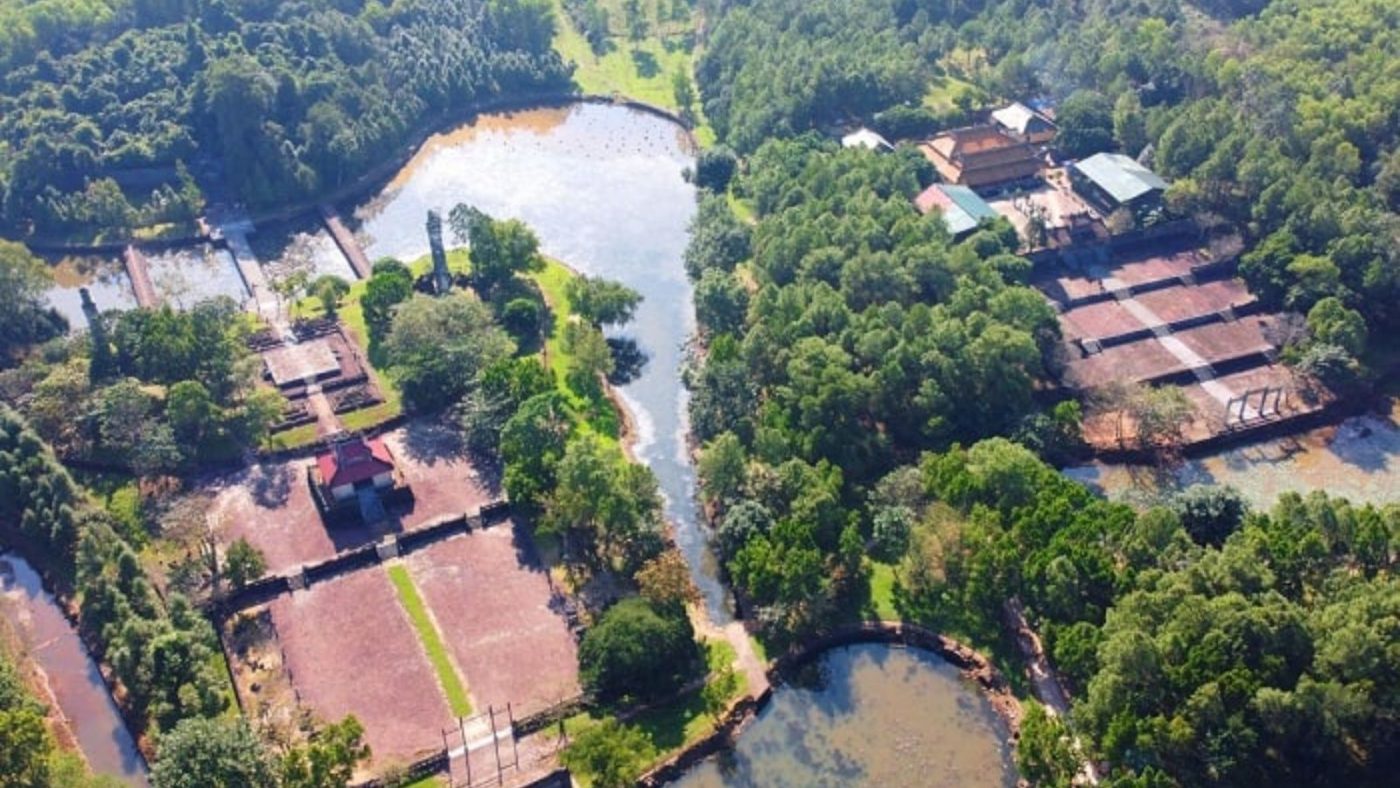
The design features a rare fusion architectural style. It blends the natural openness of Gia Long Tomb with the structured symmetry of Minh Mang Tomb. Like Gia Long Tomb, it lacks an artificial outer protective wall, known as La Thanh. Instead, it uses surrounding natural hills as a protective barrier.
The tomb features a unique Northwest orientation. This direction is quite rare for Nguyen Dynasty imperial buildings. The local feng shui layout uses Thuan Dao Mountain as the rear anchor. Vong Canh Hill acts as the Right White Tiger. Ngoc Tran Mountain serves as the Left Azure Dragon. Open paddy fields stretch toward the Perfume River, completing this peaceful setting.
Exploring the Structural Layout: Dual Parallel Axes

The Worshiping Area (Tam Axis)
We start our walk on the left axis at Dien Lake. This crescent-moon lake sits right in front of the worship space. Underground culverts connect its waters directly to Nhuan Trach Lake on the adjacent axis.
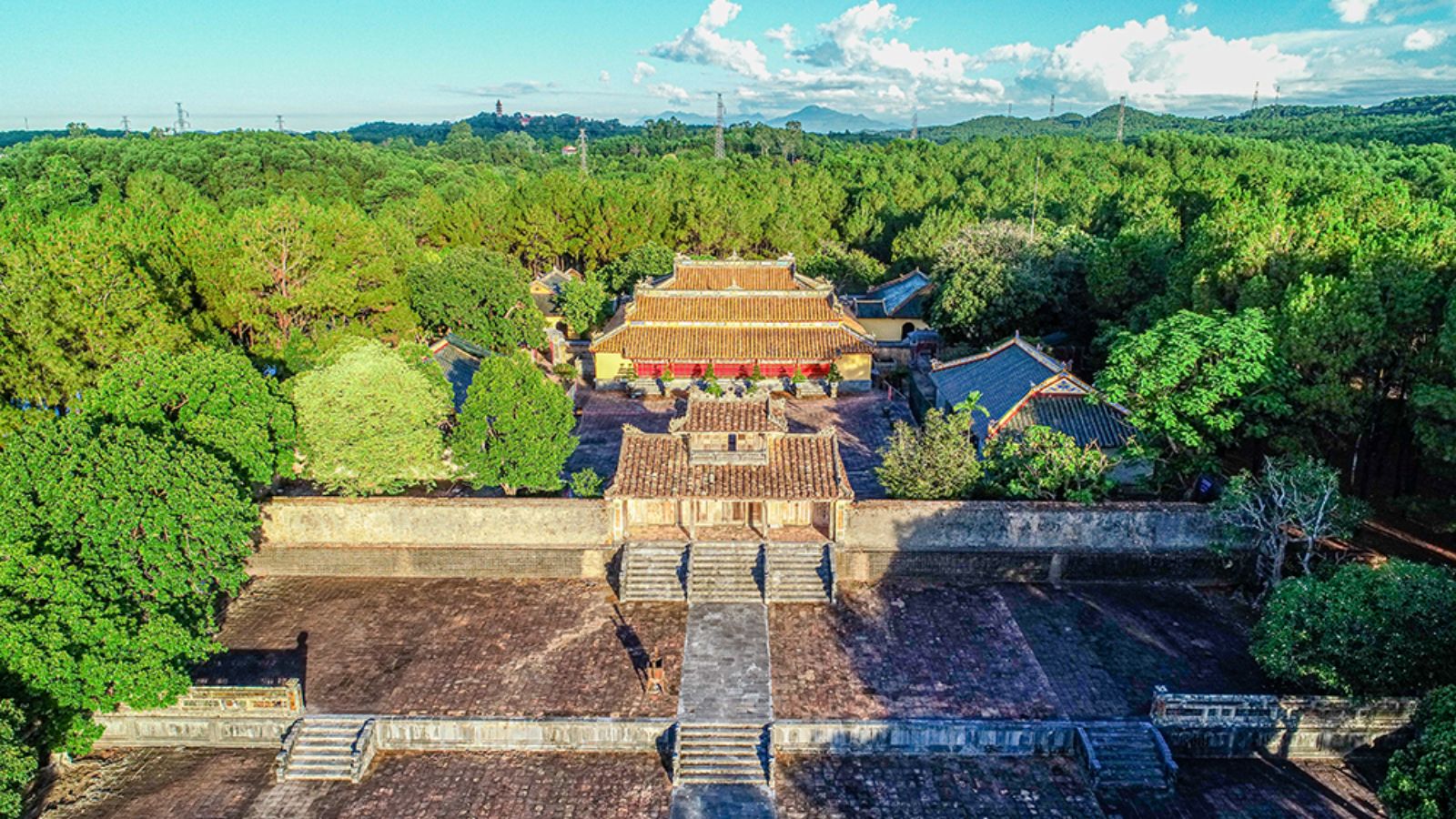
Next, we pass through Hong Trach Mon. This two-tiered gate features red tiles and three entry doors. Stepping through brings us into a quiet brick courtyard surrounded by shade trees.
Bieu Duc Temple serves as the central worship shrine on this axis. It houses the royal ancestral tablets of Emperor Thieu Tri and Queen Tu Du. The building uses traditional double-roof architecture. Inside, golden vermilion wooden pillars support the roof. Outside, decorative roof tiles display four hundred fifty carved poem reliefs alongside dragon motifs.
We love sitting nearby to sample the peaceful atmosphere. For instance, the quiet breeze through the trees creates a soothing backdrop for photos.
The Burial Area (Lang Axis)
We move to the right axis by approaching Nhuan Trach Lake. A heavy copper gate stands behind the lake, opening into the sacred burial section.
Next, we walk across the paved Bai Dinh courtyard. Two rows of stone statues line the sides. These include civil mandarins, military mandarins, stone elephants, and noble horses. They stand like permanent guardians protecting the emperor.
Bi Dinh pavilion sits directly behind the courtyard. This square structure houses the Thanh Duc Than Cong stele. King Tu Duc authored this epitaph, carving over 2,500 Chinese characters into the stone to praise his father.
Further along, we see the foundation of Duc Hinh Lau. Time and past conflicts destroyed the upper tower, leaving only the floor base today. Behind it, a divided flower garden leads to Ngung Thuy Lake. Three stone bridges cross this half-moon lake:
- Dong Hoa Bridge
- Tay Dinh Bridge
- Chanh Trung Bridge (the central bridge)
Finally, we reach Buu Thanh. This circular wall encloses the actual burial mound of Emperor Thieu Tri. The mound rests quietly on a low hill covered in ancient trees.
If you want to discover more exciting places to explore in Hue, we recommend adding this quiet stop to your full travel itinerary.
Practical Visitor Guide to the Tomb of Thieu Tri

Planning our visit here is simple and stress-free. The site sits in Cu Chanh Village, Thuy Bang Commune, Huong Thuy District. It lies just eight kilometers south of Hue city center.
We can reach the site easily by car, motorbike, or taxi. The drive takes about fifteen minutes from central Hue:
- Cross the Perfume River from the city center.
- Follow Dien Bien Phu Street southward.
- Turn right on Le Ngo Cat Street.
- Turn left onto Minh Mang Street.
- Follow Highway 19 southeast and turn right at the sign for the Mausoleum of Emperor Thieu Tri.
Entry tickets cost 50,000 VND for adults, while children enter for free. The site opens daily from 07:00 AM to 05:00 PM. We recommend visiting between January and February, when local weather stays mild and cool. Avoid late-year rainy months due to potential regional flooding.
Visitors must wear polite, modest attire covering shoulders and knees. Remember that local regulations ban photography inside sacred spaces like Buu Thanh.
Historical Restoration and UNESCO Heritage Preservation
Over the decades, environmental wear and past wars damaged parts of Thieu Tri Tomb. For example, the multi-story Duc Hinh Lau tower collapsed, leaving only its stone foundation intact. Natural moss covered many ancient brick walls, creating a rustic look.
In 2006, local authorities launched a major preservation project. Restoration crews finished their work in 2010. They repaired decaying structures while carefully preserving original 19th-century craftsmanship.
Today, Thieu Tri Tomb remains a protected landmark. UNESCO recognized the Complex of Hue Monuments as a World Cultural Heritage site in 1993. This status ensures that future generations can explore this royal treasure for years to come.
You can book a tour combine Thieu Tri Tomb with Gia Long and Dong Khanh Tomb to explore the most authentic tomb in Hue and bypass the other busy-tourist tombs.
