
Attractions
The Marble Mountains Danang: Complete Guide, Tickets & Peaks
Sep
The Marble Mountains stand as one of Da Nang’s most striking natural landmarks. Rising just outside the city, this cluster of limestone peaks holds centuries of history inside its caves and pagodas. Travelers come here for the caves, the temples, and the sweeping views from the top. Others come simply to see how nature and faith blend together on one hillside.
This guide walks through everything worth knowing, from how to get there to what fees to expect. It also covers the best caves, the top pagodas, and the ideal time to visit. By the end, planning a trip here should feel simple and clear.
The Marble Mountains At A Glance

The Marble Mountains, known locally as Ngu Hanh Son, sit just southeast of Da Nang City. The site borders the East Sea on one side and the Co Co River on the other. Some sources describe five peaks, while others count six, since one mountain splits into two smaller sections. Either way, each peak carries a name tied to the five elements: metal, wood, water, fire, and earth.
Thuy Son, the Water Mountain, is the tallest and most visited peak. It spreads across roughly 15 hectares and holds most of the famous caves and temples. The Cham people once treated this land as sacred ground. Later, Nguyen Dynasty emperors visited often, adding shrines, statues, and legends along the way. That long history is part of what makes this place feel different from a typical scenic stop.
The Five Elements: Exploring the Six Peaks of Ngũ Hành Sơn
Each mountain represents a natural element, forming a unique geological wonder.
- Thuy Son (Water Mountain): Spanning 15 hectares, this northeast peak is the largest and most famous. It hosts multiple ancient temples, deep caves, and summit formations named after the Tam Thai Stars.
- Kim Son (Metal Mountain): Resting near the historic Co Co River, this peak houses Quan The Am Pagoda, Thai Son Pagoda, and Quan Am Cave.
- Tho Son (Earth Mountain): A square-shaped sandstone hill composed of red clay. Historically, it served as a Champa civilization military base and features four temples alongside the Stacked Stone Tunnel.
- Moc Son (Wood Mountain): Running parallel to Thuy Son, this rugged cliff contains sparse vegetation, the “Co Mu” marble formation, and Ba Trung Cave.
- Hoa Son (Fire Mountain): A twin peak formation consisting of Duong Hoa Son and Am Hoa Son.
Grottoes and Caverns of the Marble Mountains

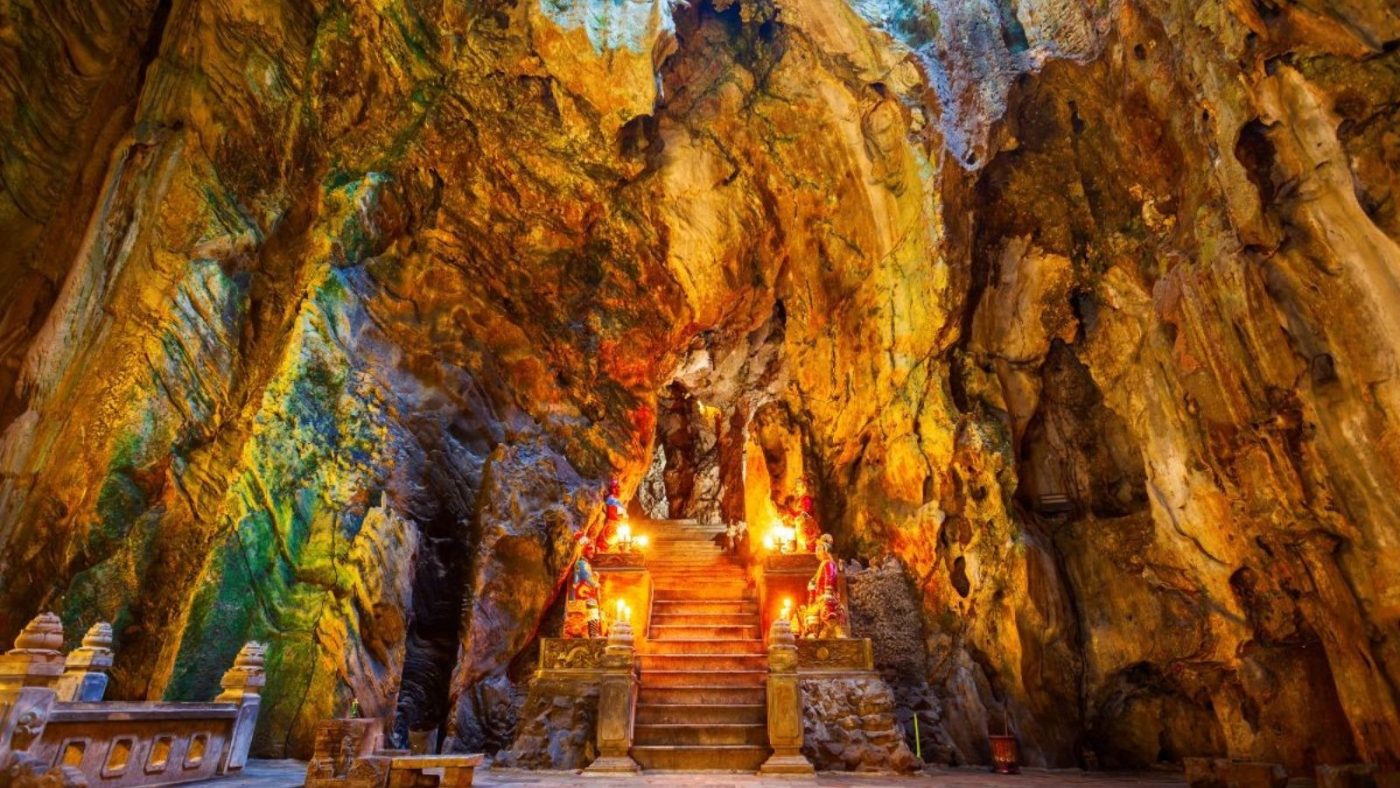
Stepping inside these limestone caves feels like entering another dimension. For instance, Huyen Khong Cave shelters an altar dedicated to the Jade Goddess Thien-Y-A-Na. Natural skylights pierce the cavern roof, illuminating ancient ritual spots where locals once swore oaths and prayed for fertility.
Just south of Thuy Son lies Âm Phủ Cave (Underworld Cave). Unlike its sunlit counterparts, this dark cavern lacks natural light entirely. Local folklore claims that marked grapefruits placed inside will miraculously resurface days later in the open sea.
Other fascinating subterranean stops include Tang Chon Cave, a valley-like cavern behind Linh Ung Pagoda featuring the Thien Long Coc skylight. You can also explore lesser-known grottoes like Van Thong Cave, Linh Nham Cave, Hoa Nghiem Cave, Thien Long Cave, Thien Phuoc Dia Cave, and Ngu Coc Cave.
Ancient Pagodas and Sacred Buddhist Landmarks
Spirituality breathes through every corner of these stone hills. Built in 1630 and expanded in 1826 by Emperor Minh Mang, Tam Thai Pagoda remains a masterpiece of royal architecture. It spans three distinct mountain tiers—Ha Thai, Trung Thai, and Thuong Thai—and preserves sacred bells alongside the “Fiery Heart” relic.
Facing east toward the ocean, Linh Ung Pagoda (Thuy Son) traces its roots back to the 17th century when it began as the Duong Chon Am hermitage. Later granted royal status by Emperor Gia Long, it now houses magnificent statues of the Avalokitesvara Bodhisattva and the Three Times Buddhas.
Down at Quan The Am Pagoda, you will find Vietnam’s first Buddhist museum. Spanning a 700-square-meter courtyard, this cultural hub displays over 200 ancient artifacts. These include Cham sculptures, bronze bells, and wooden sutra plates dating from the 7th to the 20th century.
Marble Mountains Entrance Fees and Opening Hours

Planning your trip right saves both time and money. For example, knowing the exact fees prevents unwanted surprises at the gate. Located at 81 Huyen Tran Cong Chua Street, the site opens early every morning.
- Thuy Son Peak Entry: 40,000 VND per adult, with free admission for children under 6 years old.
- Âm Phủ Cave Entry: 20,000 VND per adult, and 7,000 VND per student.
- Guided Tours: Available for 50,000 VND per group.
Furthermore, reaching the summit does not have to exhaust you. Visitors can climb over 150 stone steps or take a glass elevator for 15,000 VND one-way (or 30,000 VND round trip). Accessibility spans across Gate 01 and Gate 02. To beat the intense midday heat, I strongly recommend arriving between 7:30 AM and 8:00 AM, or visiting after 4:00 PM during summer months.
How to Get to the Marble Mountains from Da Nang
Getting here is easy, even without a private driver. The Marble Mountains Da Nang site sits about seven to eight kilometers from downtown. Most visitors reach it by taxi, motorbike, or a rented car in under twenty minutes.
The location also works well for a longer day out. Non Nuoc Beach sits right beside the mountains, so a beach stop fits naturally into the same trip. From there, the coastal road leads straight toward Hoi An. Many travelers combine both stops in a single day. If Hoi An is next on the list, this collection of top Hoi An experiences makes a useful next stop for planning.
Suggested Itinerary for a Half-Day Visit
A half-day works well for most travelers, roughly three to four hours. Starting at Thuy Son makes sense, since it holds the largest number of sights.
Here’s a simple order to follow:
- Enter through Gate 01 or Gate 02, then choose stairs or the elevator.
- Visit Linh Ung Pagoda first, then walk toward Tam Thai Pagoda.
- Explore Huyen Khong Cave and Am Phu Cave next.
- Climb to Vong Giang Dai or Vong Hai Dai for the view.
- Head down and grab a quick snack near the base.
After finishing here, many travelers continue toward Hoi An Ancient Town. The drive takes about thirty minutes along a scenic coastal road. For a full breakdown of stops, this guide to must-see spots in Hoi An covers the rest of the day nicely.
Non Nuoc Stone Carving Village Nearby
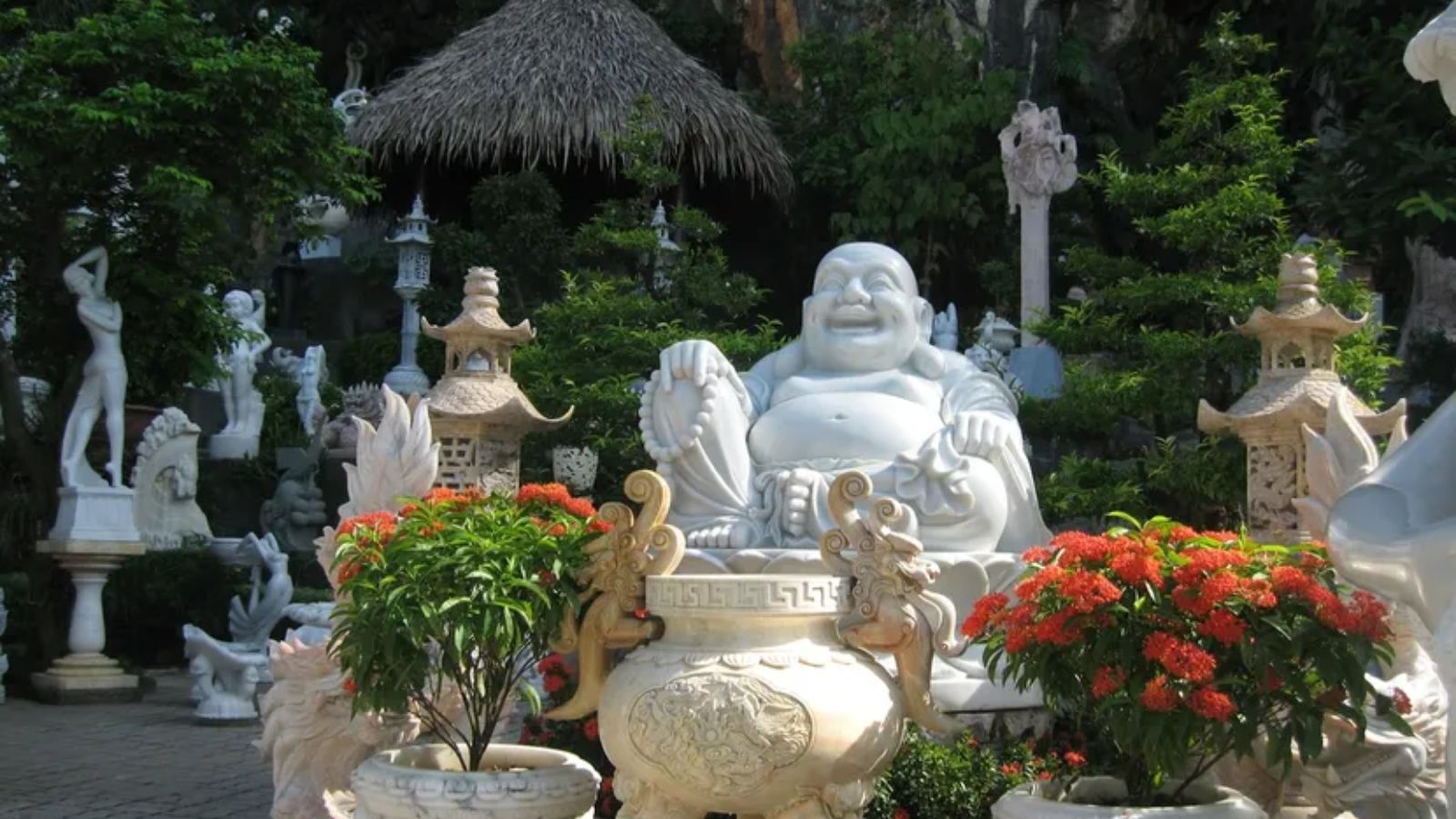
Right at the base of the mountains sits the Non Nuoc Stone Carving Village. Records trace the craft back to the 17th century, brought here from Thanh Hoa province.
Artisans still work with marble and stone today, shaping statues, bowls, and decorative pieces. Many pieces get exported internationally, though the village itself remains small and traditional. In 2014, it earned recognition as a National Intangible Cultural Heritage site. Walking through feels like a live demo of a centuries-old skill.
The Avalokitesvara Bodhisattva Festival
Every year, the mountains host the Avalokitesvara Bodhisattva Festival, one of Vietnam’s recognized national folk festivals. It falls on the 17th to 19th day of the second lunar month.
The event began in 1962, tied to the discovery of a natural stalactite statue years earlier. It blends solemn Buddhist rituals with lively cultural performances over three days. Local residents and visitors both take part, filling the mountain paths with music and prayer. Timing a trip around this festival adds a completely different layer to the visit.
Tips Before You Visit
A few small things make the trip smoother.
- Wear comfortable shoes, since stone steps are uneven in places.
- Bring water and a hat, especially during summer visits.
- Dress modestly, as this remains an active spiritual site.
- Remove shoes and hats before entering any pagoda.
- Carry small VND notes for tickets and snacks.
None of these steps take much effort, but skipping them can turn a smooth day into a rough one. A simple sample checklist like this one is worth saving before the trip.
Whether the plan includes caves, pagodas, or a quiet walk through Non Nuoc Village, the Marble Mountains offer something worth the short trip from Da Nang.
